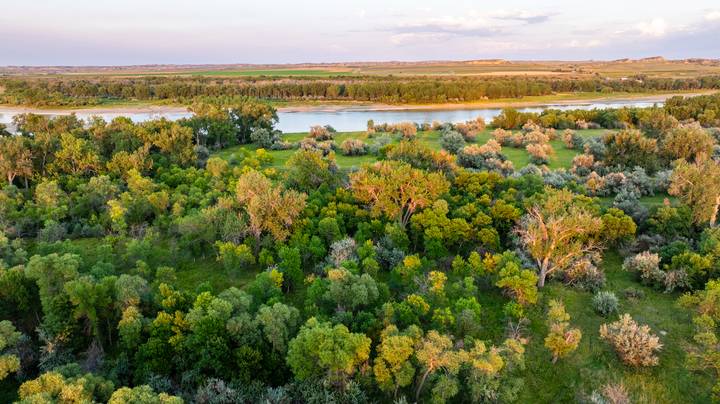
The acreage number on a listing tells you almost nothing about how a place hunts. A tight piece of ground with bedding cover, a feed source and a travel route between them will usually hunt better than a bigger, flat pasture with nowhere for animals to hide. Start with how the property is put together, then look at the size.
Start with cover, not acreage
Look at where animals can bed and feel secure: timber, brush, draws and river bottoms. Then find the feed: ag fields, hay ground, grass. The places where cover and feed meet are where your stands and blinds will end up.
On Savage Bottomlands, my listing on the Yellowstone near Savage, thick cottonwood timber gives deer bedding cover, with irrigated fields to the west for feed. The layout lets you get to the stands without walking through the bedding areas. That arrangement matters more than the 189 acres on the flyer.
Water anchors everything
A year-round creek, a river bottom or a reliable stock pond changes how game uses a property, especially in late summer and early season. Look at where the water sits relative to cover and feed, not just whether there is water somewhere on the place. If the water comes from wells or springs, ask for the well logs and water records. In Montana, well logs are public through the Ground Water Information Center.
Know the hunting district before you know the price
Every acre in Montana sits inside a Montana Fish, Wildlife & Parks hunting district. The district sets the species, seasons and how hard tags are to draw. Two properties that look alike on a map can hunt very differently on paper. Before you get attached to a listing, read the current FWP regulations for that district.
Landowner preference: check the acreage
Montana gives landowners preference in some big game drawings, but only if the property meets FWP's requirements. For 2026, FWP lists these minimums:
- Deer permits, Deer B and antelope: at least 160 acres in the hunting district, used primarily for agriculture.
- Elk permits and Elk B: at least 640 contiguous acres in the district, with documented elk use.
Preference applies only to your first-choice district, and lessees don't qualify. These rules change, so confirm them with FWP for the year you're buying in. A property that clears the deer threshold may not clear the elk one.
Check the permit boundary, not just the district map
Some elk permits cover more than one hunting district, or only part of one. A property near a district line can fall under a different permit than the map suggests. On Sumatra Hysham 640 in Treasure County, part of Hunting District 701 falls under the HD 590 elk permit. The property sat right on that line, so its 640 acres let my buyer qualify for preference on the same permit as his other land, where the elk hunting is better.
Acreage can also be the whole reason for a move. A seller I worked with sold End of the Road Ranch in the Bull Mountains near Roundup and, through a 1031 exchange, bought Sarpy Creek Ranch, 680 acres in Treasure County, so he would have enough land to qualify for elk preference.
Access, neighbors and pressure
How you get onto a property, and what is happening around it, affects your hunting as much as anything on your own deed. Confirm legal access, not just a gate that has always been used. Look at who borders the place: a county road, public land, a neighbor who leases to an outfitter. Each one changes how much pressure your animals see.
Infrastructure is a bonus, not a reason
Stands, blinds, food plots and trails that convey with the sale can save you a season of setup. On a close call between two pieces of ground, improvements built with care are a real point in a property's favor. They should never be why you buy.
This article is general information, not legal, tax, water-rights or appraisal advice. Rules change; confirm current requirements with the agency or a qualified professional for your property.